Tree Removal — Cost, Process and Scheduling in Port St Lucie
What tree removal involves in Port St Lucie: warning signs, the step-by-step process, how sandy soil and storms change the work, and how to decide.
When removal is the right call
Not every troubled tree needs to come down, but when one does, the decision usually announces itself. A trunk that leans more than it used to, soil heaving or cracking on one side of the root plate, large dead limbs hanging over a roof, mushroom-like conks growing at the base, or a split that runs deep into the main stem are all signs that a tree has moved past trimming and into removal territory. In Port St Lucie, where summer storms arrive fast and the water table sits high, a compromised tree is not just an eyesore — it is a loading problem waiting for the next 50-mph gust.
This page explains what a removal actually involves, what drives the cost, and how our sandy soil and storm season change the work. If you are not sure whether a tree is salvageable, a tree health assessment looks at the whole tree first. If the canopy is the only problem, tree trimming may be the better, cheaper path.
How a tree removal is done
Removal is a sequence, not a single cut. Each step is planned around what is below and beside the tree.
-
Assessment and drop-zone planning
We look at lean, decay, nearby structures, power lines, and fences, then decide whether the tree can be felled in one piece or must be dismantled in sections. In tight Port St Lucie lots, sectional removal is usually the answer.
-
Setting up and roping
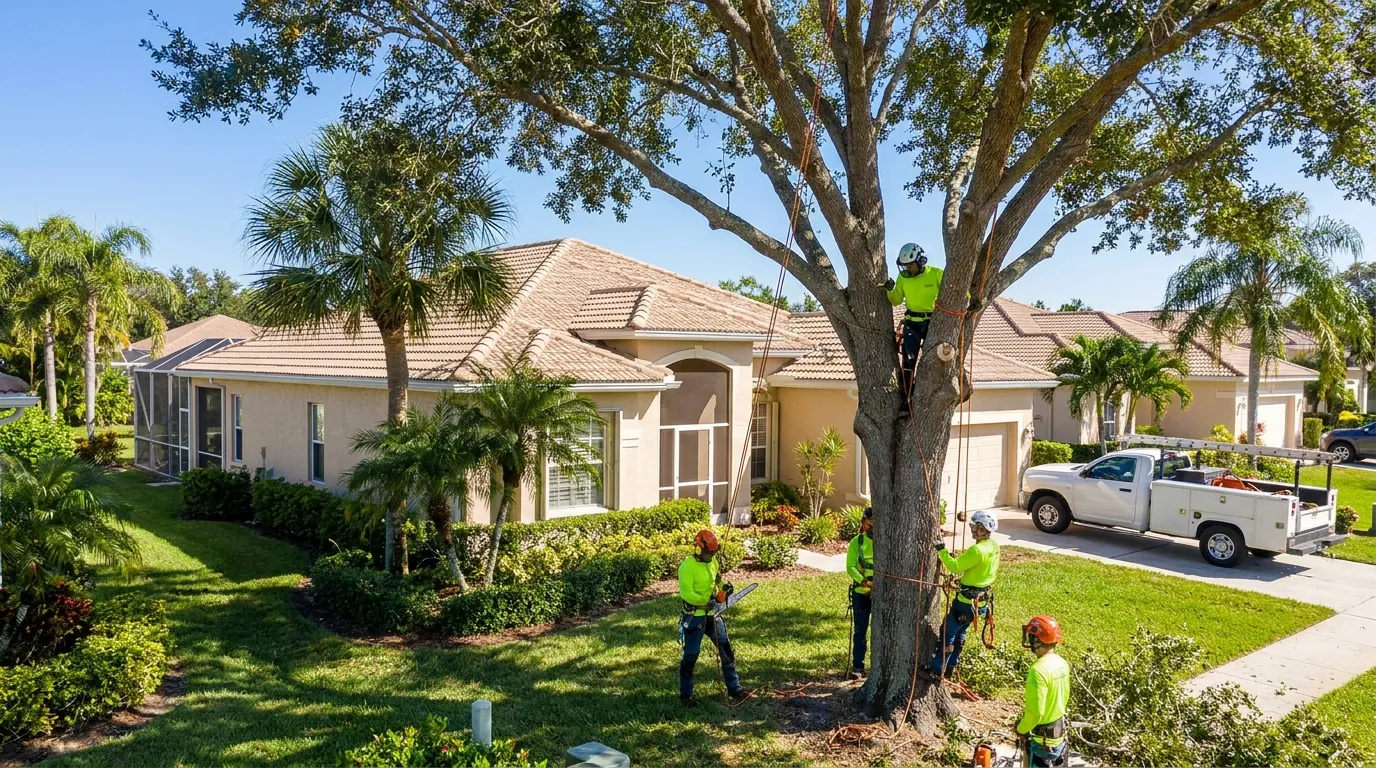
Limbs and sections are often lowered on rigging lines rather than dropped, so nothing lands on a roof, pool cage, or neighbor's property. This is the slow, careful part that keeps the job safe.
-
Sectional takedown
A climber or lift works top-down, removing limbs and then the trunk in manageable pieces. Each piece is cut, controlled, and brought to the ground in the planned drop zone.
-
Cleanup and hauling
Brush is chipped, logs are cut to size, and debris is hauled off. We leave the stump at the height you want — low if you plan on grinding, higher if you want a handhold for the grinder.
-
Stump decision
The stump stays unless you want it gone. Most homeowners pair removal with [stump grinding](/services/stump-grinding/) so the area can be replanted or paved over.
How Port St Lucie soil and storms change the job
Our sandy soils and high water table matter more than people expect. Sand drains fast but holds roots loosely, so trees here anchor shallower than they would in heavy clay. After a wet stretch — and summer afternoons deliver plenty of rain — saturated sand loses grip and a leaning tree can uproot entirely in wind. That same softness is why we watch the root plate: a tree that is quietly tipping in soft ground is a higher priority than its canopy alone would suggest.
Species matters too. Fast-growing favorites like laurel oak and queen palm, plus common invasives such as Brazilian pepper and Australian pine, tend to fail in predictable ways — brittle wood, weak crotches, and shallow roots. Native live oaks are far stronger but grow massive, which turns their removal into a large, carefully staged job. Hurricane and tropical-storm season, roughly June through November, is when most emergency removals happen; if a tree already worries you, it is far cheaper and safer to address it on a calm day than after it comes down. For trees already hit by wind, see our emergency tree service.
Get a tree removal quote in Port St Lucie
Tell us what you are seeing — a lean, dead limbs, a split trunk, or a tree too close to the house — and we will come look and give you a clear plan and price.
Serving Port St Lucie, White City, Jensen Beach, Fort Pierce, and nearby Treasure Coast towns.
Frequently asked questions
How much does tree removal cost in Port St Lucie?
Price depends on height, trunk diameter, species, and access — a small palm in an open yard is a fraction of a large live oak over a roof. Tight lots, power lines, and the need to rope sections down all add time and therefore cost. We quote after seeing the tree so the number is real, not a guess.
Do you remove the stump too?
The stump is left after removal unless you ask for grinding. Most homeowners add stump grinding so the ground can be replanted, sodded, or paved over without a trip hazard or regrowth.
Can you remove a tree that's close to my house or pool cage?
Yes. Trees near structures are dismantled in sections and lowered on rigging lines instead of being felled whole, which is standard for Port St Lucie's closely spaced lots. It takes longer but protects the house, cage, and fence.
Is it better to remove a tree before hurricane season?
If a tree is already leaning, decayed, or dead, yes. Addressing it on a calm day is safer and less expensive than dealing with it after a storm drops it on a roof or across a driveway.