Tree Health Assessment in Port St Lucie
A tree health assessment in Port St Lucie checks for decay, root issues, and storm risk before you decide to keep, treat, or remove a tree.
Why a tree health assessment matters here
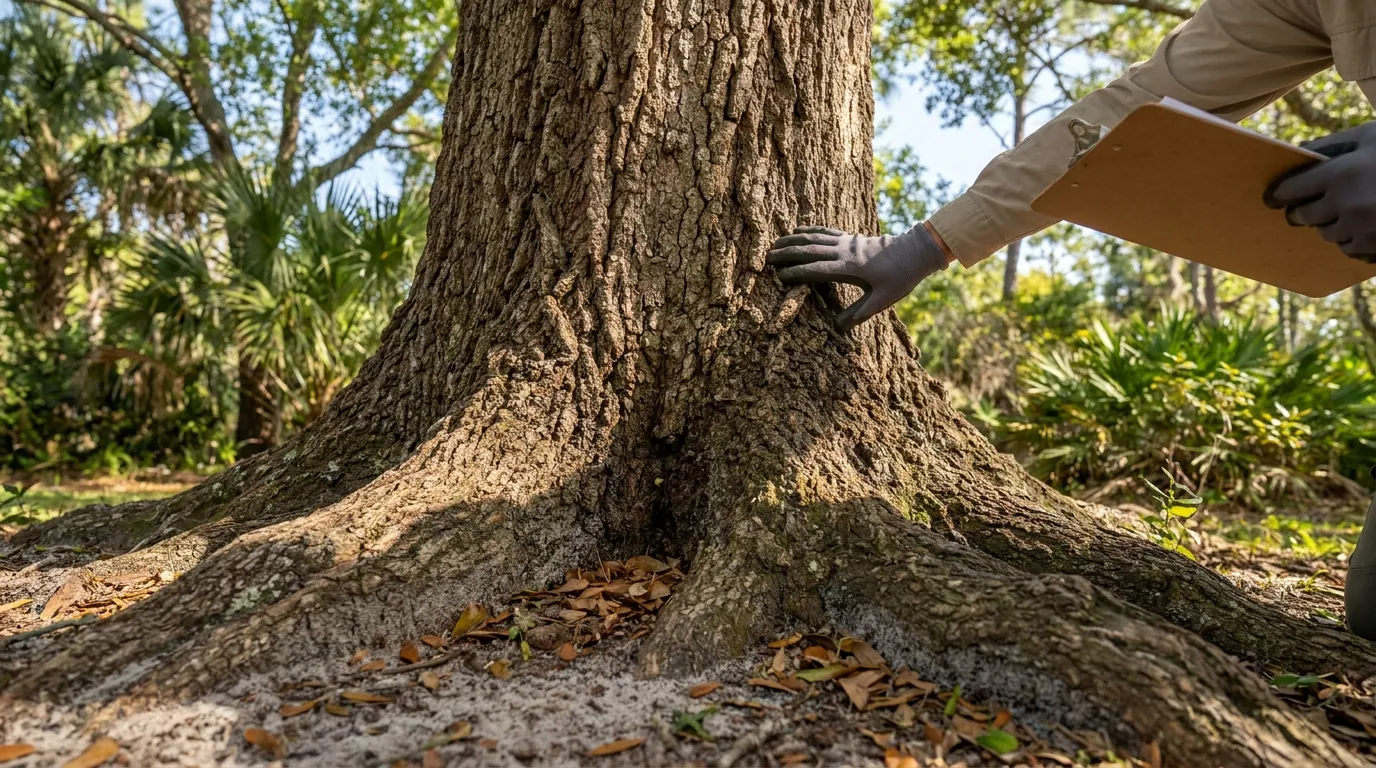
Most homeowners only think about a tree's condition after something goes wrong — a limb drops, a storm passes, or the tree starts looking thin and sickly. A tree health assessment flips that around. It is a close look at a tree while there is still time to make a calm decision about keeping it, caring for it, or taking it down on your own schedule rather than during a cleanup.
In Port St Lucie, the conditions work against trees in ways that are easy to miss. High humidity feeds fungal decay. Sandy soil drains fast but holds little, so roots spread wide and shallow instead of deep. A high water table means those shallow roots often sit in saturated ground during the wet season, which weakens the anchorage that keeps a tall tree upright. A tree can look full and green and still be poorly rooted or hollow at the base.
An assessment gives you a clear picture of what you are actually dealing with, so the choice to keep or remove is based on the tree's real condition instead of a guess.
What the assessment looks at
A thorough look at a tree covers the parts you can see and the clues about the parts you can't.
-
Lean, posture, and root plate
We check whether the tree is leaning, whether that lean is new, and whether the soil is lifting or cracking at the base. In our saturated sandy soil, a shifting root plate is one of the clearest warnings that a tree is becoming unstable.
-
Trunk and branch structure
Cracks, seams, cavities, weak forks, and dead limbs all tell us about the tree's structural strength. Co-dominant stems with included bark are a common failure point in storms around here.
-
Signs of decay and disease
Fungal brackets, soft or peeling bark, oozing, and thinning canopy point to internal decay the humidity in this area encourages. Where decay is present, we judge how far it has advanced.
-
Surroundings and targets
A tree's risk depends on what is under it. We note the house, driveway, pool cage, play areas, and lines nearby, because a flawed tree over open grass is a very different decision than the same tree over a bedroom.
Turning the assessment into a decision
The point of the visit is a straight answer. Some trees come back sound, and the right move is to leave them be or schedule tree trimming to lighten weight and clear deadwood. Others have correctable problems — a few poor limbs, a heavy side — that pruning can manage for years. And some are far enough gone, or poorly enough rooted, that the honest recommendation is planned tree removal before the next storm makes the call for you.
We lay out what we see, what it likely means over the next few seasons, and the options with their trade-offs. You decide. There is no benefit in pushing removal on a tree that can be kept, and no benefit in trimming a tree whose structure has already failed.
An assessment is especially worth it before hurricane season, after a close call in a storm, or when you are clearing a property and want to know which trees to keep. It pairs naturally with lot and brush clearing when you are deciding what stays on a parcel.
Not sure whether a tree is safe?
Describe what's worrying you — a lean, a crack, a thinning crown, a tree too close to the house — and we'll take a look and give you a clear, honest read on it.
Serving Port St Lucie and the surrounding Treasure Coast area.
Frequently asked questions
How do I know if a tree needs to be looked at?
Watch for a new lean, cracks or cavities in the trunk, mushrooms at the base, large dead limbs, or a crown that is thinning while nearby trees stay full. Any of these, especially on a tree near your house, is worth a closer look.
Can a tree that looks healthy still be a risk?
Yes. A tree can hold a full green canopy while being hollow at the base or shallowly rooted in saturated sand. That is exactly why an assessment is useful — it reads the structure and roots, not just the leaves you can see from the yard.
Will you always recommend removal?
No. Many trees come back sound or can be managed with pruning for years. We only recommend removal when the condition or rooting genuinely makes the tree a hazard, and we explain why so the decision is yours.
When is the best time to have trees assessed?
Before hurricane season is ideal, so you have time to act calmly on any problem trees. It's also smart after a storm with high winds or when you're clearing a property and deciding which trees are worth keeping.