Tree removal service
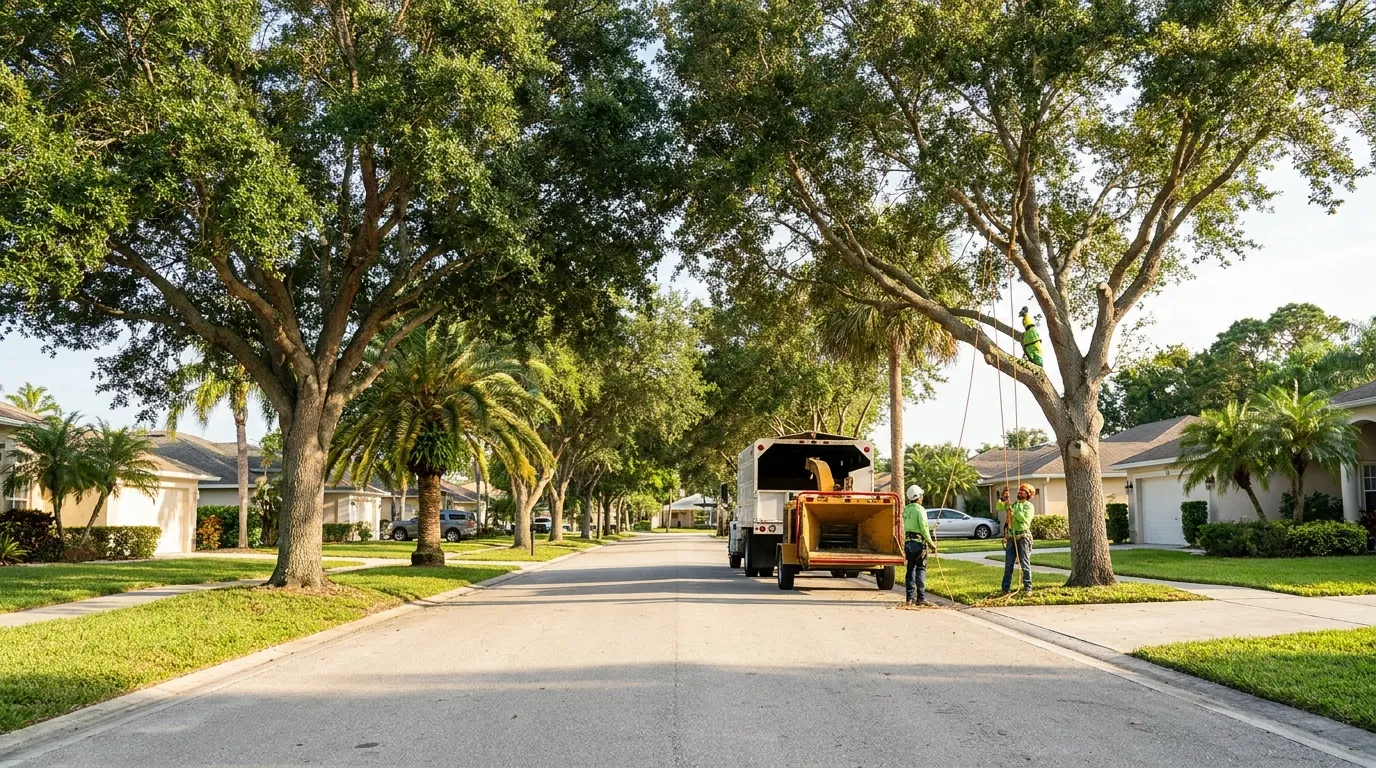
Full removal of dead, dying, leaning, or hazard trees — including tight-access takedowns near houses, fences, and utility lines. We plan the drop or the rigging around Port St Lucie's compact lots and soft ground.
Port St Lucie Tree Care
Tree removal, trimming, and cleanup grounded in the way trees grow — and fail — in our sandy, humid coastal soil.
Serving Port St Lucie, FL and the surrounding area.
Port St Lucie sits on flat, sandy ground with a water table that rides close to the surface for much of the year. That combination changes how trees anchor themselves, how fast they lean, and how they behave when a summer storm rolls in off the coast. A live oak that looks solid in April can loosen its footing after weeks of saturated soil, and a laurel oak that has quietly hollowed at the base often gives no warning until a gust finds the weak point. This site is for homeowners who want to understand what they are looking at before they decide whether a tree stays or goes.
We focus on the questions that actually matter here: Is that lean new or has it always been there? Are the roots lifting because of rot, or because the soil simply cannot hold a top-heavy canopy in wet season? Is a tree close enough to the house, the septic drainfield, or the power drop to justify removal, or would a good round of tree trimming and structural pruning buy years? Straight answers to those questions save money and prevent the kind of failure that damages a roof.
Whether you need a full tree removal service, storm cleanup, or replacement planting after a tree comes out, the goal is the same: work that respects your property, your budget, and the realities of growing trees on the Treasure Coast.
Two local conditions dominate every job in this area: sandy soil and a high water table. Sand drains fast, but it also gives roots less to grip. Shallow-rooted species like laurel oak and some pines spread their roots wide rather than deep, and when the ground stays wet through the rainy season, that root plate can loosen under the weight of a full canopy. This is why so many trees fail not in a hurricane but in an ordinary summer squall after days of rain — the soil is already saturated and the wind only has to finish the job.
High humidity is the other constant. Warm, damp air feeds fungal decay, and cavities that open at pruning wounds, storm breaks, or the base of a tree spread faster here than they would in a drier climate. A hollow you can fit a fist into today may be much larger a year from now. That is why we look closely at trunk cavities, mushrooms at the root flare, and bark that sloughs off in sheets — those are decay signals worth acting on before storm season.
Season matters, too. The stretch from June through November brings the heaviest rain and the tropical systems, so the best time to inspect, thin, and remove hazard trees is the dry winter and spring window, when soil is firmer and equipment does less damage to the yard. Trimming for wind resistance ahead of hurricane season is one of the most useful things a Port St Lucie homeowner can do.
Three core services, each shaped by local soil, humidity, and storm exposure.
Full removal of dead, dying, leaning, or hazard trees — including tight-access takedowns near houses, fences, and utility lines. We plan the drop or the rigging around Port St Lucie's compact lots and soft ground.
Storm cleanup, pruning of damaged limbs, cabling for weak unions, and stump grinding. Often the right move is repair and thinning rather than removal — we help you tell the difference.
Replacement planting after a tree comes out — choosing species that suit sandy soil and a high water table, and siting them a safe distance from the house, driveway, and drainfield.
Practical answers to the questions we hear most in Port St Lucie, FL.
How to compare tree removal contractors in Port St Lucie: what to ask, what red flags to watch for, and how local sandy soil affects the job.
A step-by-step look at how tree removal actually works in Port St Lucie, from assessment and rigging to stump grinding and cleanup on sandy soil.
It comes down to the tree's health and its position. A structurally sound tree with a few overgrown or damaged limbs is usually a candidate for pruning, while significant trunk decay, root-plate lifting, or a new lean toward a structure often points to removal. We assess both before recommending anything.
Our sandy soil holds roots loosely, and during the rainy season the ground stays saturated for long stretches. A saturated root plate under a heavy canopy can give way in ordinary storm winds, not just hurricanes, which is why pre-season thinning matters here.
The drier winter and spring months are usually ideal. The soil is firmer, so heavy equipment does less damage to the yard, and getting hazard trees down before June's storm season reduces risk to your home.
Yes. Removal, stump grinding, and hauling of debris are part of the tree removal repair and cleanup work we cover. Grinding the stump also prevents the regrowth and pest issues that a left-behind stump can attract in our humid climate.
Port St Lucie plus nearby Treasure Coast communities including White City, Indian River Estates, Jensen Beach, Palm City, Fort Pierce, and Stuart.
Tell us what you're seeing — a lean, a crack, roots lifting the lawn, or a tree too close to the house — and we'll walk you through the options. Learn more about how we work on the about page.
Call using the number on this page to talk through your tree.
Port St Lucie and nearby Treasure Coast communities.