Leaning after a storm
A tree that shifts and lifts soil on one side has likely torn roots. In Port St Lucie's sandy ground, a fresh lean after high wind is a strong signal the root plate has failed and the tree may come down on its own.
Tree removal service in Port St Lucie for hazardous, dead, or crowded trees. Learn the process, warning signs, and how local sandy soil changes the job.
A tree removal service near me search usually starts with a specific worry: a big oak leaning toward the house after a storm, a dead cabbage palm dropping fronds, or roots crowding a septic drainfield. In Port St Lucie those worries are common because the trees here grow fast in a warm, wet climate and then meet sandy soils that give roots very little to grip. When you searching for a tree care service near me, you are usually deciding whether a tree can be saved or whether it has become a liability.
This page explains how we approach full tree removal, the warning signs that a tree has crossed from healthy to hazardous, and the way local ground conditions change the work. If your tree is damaged but may still be salvageable, start with our tree removal repair page instead — removal is not always the right answer, and we say so when it isn't.
Removal is the last step in a range of options. We would rather prune, brace, or monitor a tree than take it down, but some trees are simply too far gone, too close to a structure, or too unstable in loose soil to leave standing.
Any one of these on its own may not mean removal — but several together usually do.
A tree that shifts and lifts soil on one side has likely torn roots. In Port St Lucie's sandy ground, a fresh lean after high wind is a strong signal the root plate has failed and the tree may come down on its own.
Fungal conks, soft or crumbling bark, and large cavities point to internal decay. High humidity here speeds up rot, so a trunk can be far weaker than it looks from the outside.
Dead wood over a roof, driveway, or play area drops without warning. If the deadwood is spread through the crown rather than isolated, the whole tree is often declining.
Roots chasing water in dry sandy soil can crack driveways, patios, and pool decks. When they threaten a foundation or a drainfield, removal may be the only way to stop the damage.
Every job is different, but a typical Port St Lucie removal follows these steps.
We walk the site, check the lean, the soil around the base, the health of the trunk and crown, and what sits within falling distance — house, fence, pool cage, power drop.
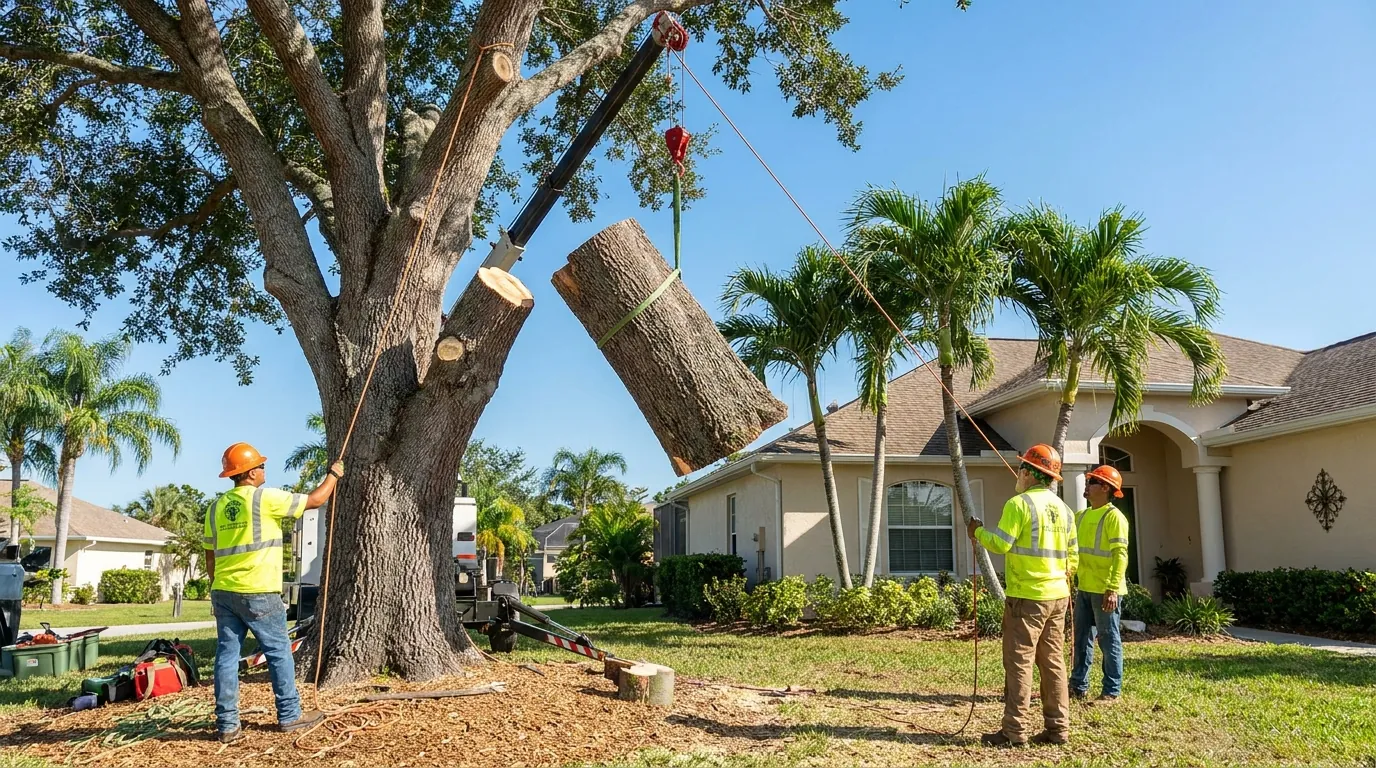
A tree with open space around it may be felled in one piece. Most residential trees here sit close to structures, so they are climbed or reached with equipment and taken down in sections that are lowered by rope.
Limbs and trunk segments are cut and controlled to the ground, keeping weight away from roofs, screens, and landscaping. Loose sandy soil means we set rigging anchors carefully.
The stump is ground below grade or left tall by request, wood and debris are cleared, and the area is raked. We talk through whether you want to replant, which our [tree removal installation](/services/tree-removal-installation/) service covers.
Port St Lucie sits on sandy, fast-draining soil with a high water table, and that combination matters more than most homeowners expect. Sandy ground gives roots a weak anchor, so trees that would stand firm in clay can tip in a Treasure Coast storm. After heavy summer rain the water table rises, saturating the root zone and making already-loose soil even less stable — which is why we check the ground around the base, not just the tree itself.
High humidity feeds fungal decay year-round, so interior rot advances faster here than in drier climates. A trunk that looks solid can be hollow behind a thin shell. Hurricane season, roughly June through November, is when marginal trees fail, so late spring is a sensible time to remove a tree you already know is a hazard rather than wait for the wind to do it.
Because much of the year is warm and growth is quick, cut roots and stumps can resprout, and open soil fills in with weeds. We factor that into cleanup and any replanting so you are not left with new problems. If you are still weighing options, our about page explains how a visit works, or contact us to set one up.
Not always. A tree that has leaned since it was young may be perfectly stable. A tree that leaned suddenly after a storm, with soil lifting on one side, has likely torn its roots and usually should come out.
Trees near structures are taken down in controlled sections rather than felled whole. Each piece is roped and lowered so weight never falls freely toward a screen enclosure, roof, or fence.
Stump grinding is offered as part of the job or separately. In sandy soil stumps can resprout, so grinding below grade is usually the cleaner finish if you want to reuse the space.
It's the most important time to have already dealt with a hazardous tree. Removing a known-risk tree in spring, before the June-through-November storm window, avoids emergency work in worse conditions.
Call to describe the problem and get a quote for work in Port St Lucie, FL.