Storm damage cleanup
Removing broken and hanging limbs, clearing debris, and making clean cuts where jagged breaks have left torn wood. Clean cuts heal better and resist the decay that Port St Lucie's humidity encourages.
Storm-damaged tree repair in Port St Lucie — pruning, cabling, and cleanup to save trees that aren't beyond help. See how humid, sandy conditions change it.
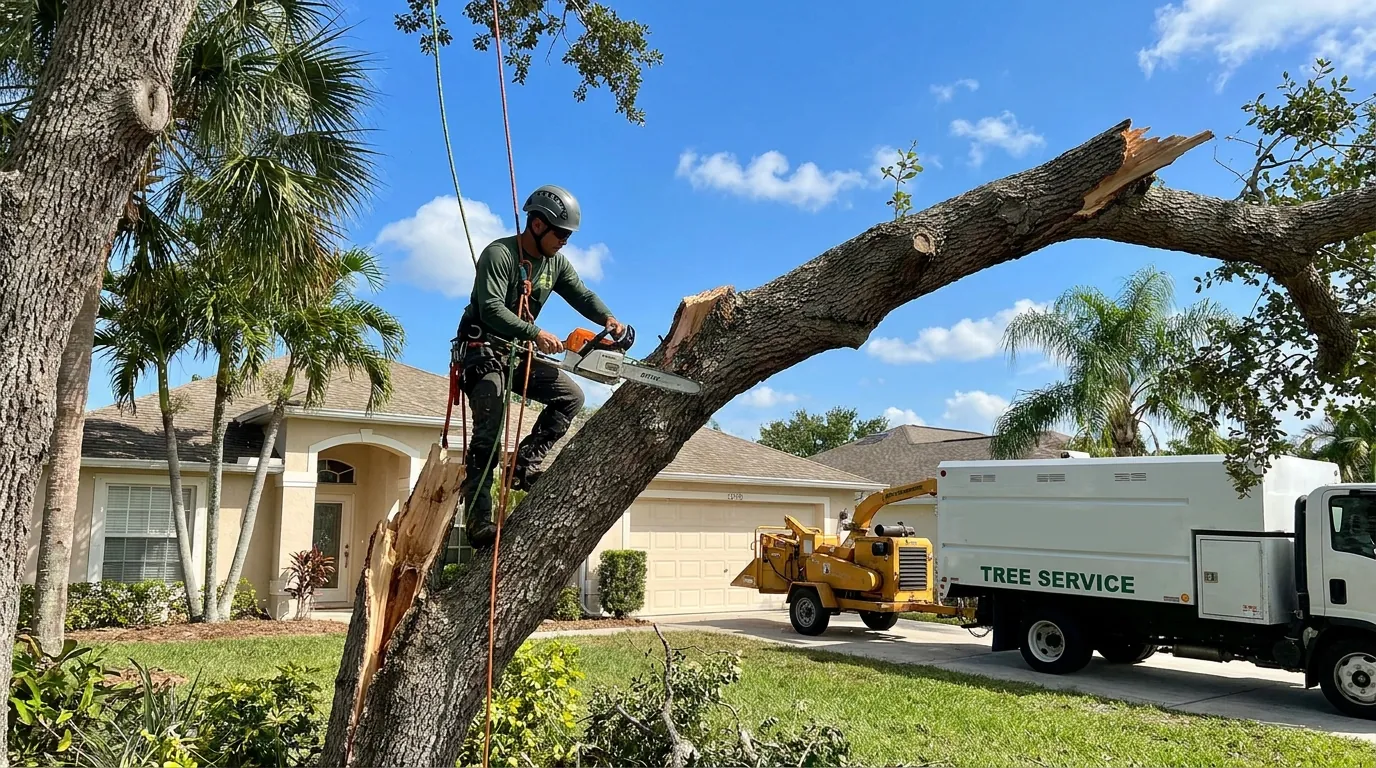
After a Treasure Coast storm, a lot of trees look worse than they are. A split limb, a torn branch, or a partial lean can often be corrected without removing the whole tree. This page covers repair-focused work — cleanup, corrective pruning, cabling, and damage assessment — for Port St Lucie trees that still have a future.
The goal is honest triage. Some trees can be pruned back to a safe, balanced shape and go on for years. Others have structural damage that no repair will fix, and pretending otherwise just delays a hazard. When a tree is past saving, we point you to our tree removal service rather than sell you repairs that won't hold.
Repair work matters most in the weeks after severe weather, when hanging limbs and cracked unions are the immediate danger even if the tree survives.
What repair looks like depends on the damage and the species.
Removing broken and hanging limbs, clearing debris, and making clean cuts where jagged breaks have left torn wood. Clean cuts heal better and resist the decay that Port St Lucie's humidity encourages.
Rebalancing a crown that lost major limbs on one side, reducing weight that pulls a tree off-center, and shaping regrowth over a season or two so the tree recovers a stable form.
Where a trunk has a weak fork or a heavy limb worth keeping, hardware can support it. This is only appropriate on otherwise-sound trees — it is not a fix for a rotten trunk.
A straight answer on whether a tree is safe to keep. We look at root lift, trunk cracks, decay, and how much live crown remains, then tell you whether repair or removal makes sense.
Repair decisions run in a rough order.
Hanging and broken limbs come down before anything else, so nothing drops on people or property while the tree is being evaluated.
We check the root plate for lifting, the trunk for cracks and decay, and the ratio of live to dead wood. Sandy soil and high humidity both work against a damaged tree here.
If the structure is sound, we prune, cable, or brace as needed. If it isn't, we explain why removal is safer and how the [tree removal service](/services/tree-removal-service/) would proceed.
Trees recovering from damage often need a second visit as they push new growth. We set expectations so you know what the tree should look like next season.
The same damage heals differently in Port St Lucie than it would in a cooler, drier place. High humidity means exposed wood invites fungal decay quickly, so how a break is cut — clean, at the right point — has a real effect on whether the tree recovers. A ragged storm break left alone often becomes an entry point for rot.
Sandy soil and a high water table shape the root question. If a storm has partly lifted the root plate, the loose ground under the tree may not re-anchor it, and no amount of crown pruning will make an unstable base safe. That is often the deciding factor between repair and removal, and it is why we look at the soil around the trunk closely.
Fast growth in the warm months works in your favor for restoration — a well-pruned tree fills back in relatively quickly. If replanting turns out to be the better path, our tree removal installation service covers choosing and setting a replacement, and you can contact us to arrange an assessment.
Sometimes. A minor split at a branch can be pruned or braced. A trunk split down the main stem is usually structural and unsafe to keep, especially in loose sandy soil.
As soon as it's safe. Hanging limbs are the immediate hazard, and clean cuts on fresh breaks heal far better than breaks left open to humidity and decay.
Cabling supports a fork on an otherwise-healthy tree, but it isn't permanent and needs occasional inspection. It is never a substitute for removing a tree with a rotten or cracked trunk.
Given the fast growing season here, a properly pruned tree usually rebalances over a season or two. Severely one-sided trees take longer and may need a follow-up visit.
Call to describe the problem and get a quote for work in Port St Lucie, FL.